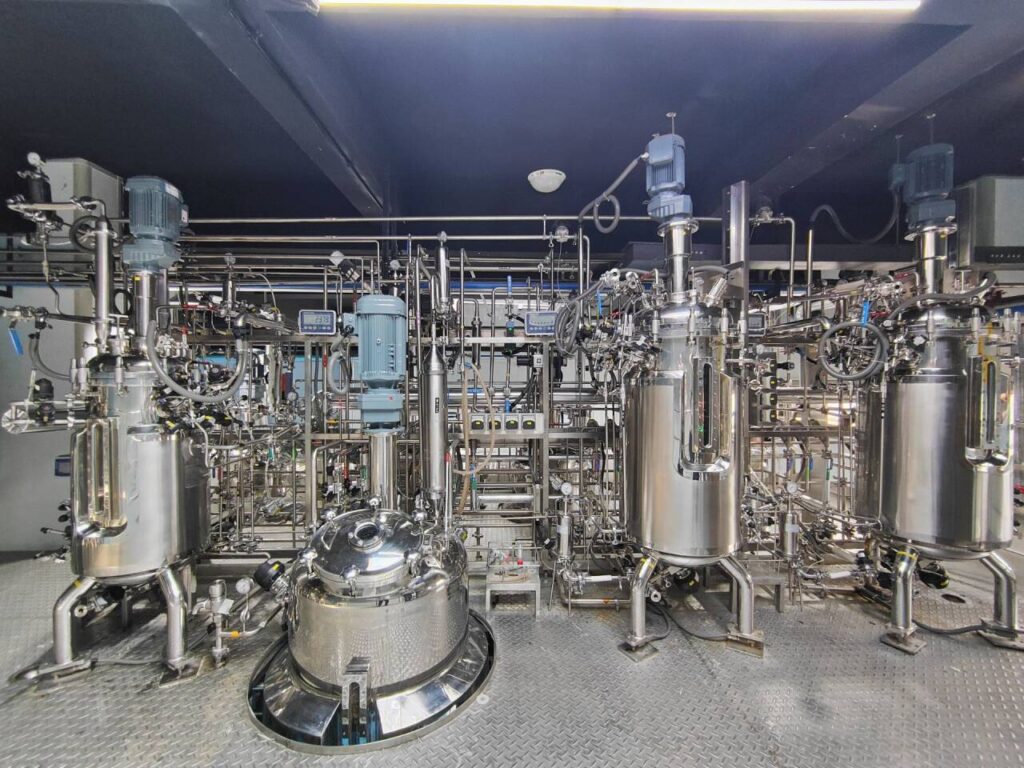
IMARC Group’s latest research report, titled “Bioreactors Market Size, Share, Trends, and Forecast by Type, Usage, Scale, Control Type, and Region, 2025-2033,” offers a comprehensive analysis of the industry, which comprises insights on the bioreactors market revenue. The report also includes competitor and regional analysis, and contemporary advancements in the market. the global bioreactors market size was valued at USD 8.0 Billion in 2024. Looking forward, IMARC Group estimates the market to reach USD 19.6 Billion by 2033, exhibiting a CAGR of 10.4% during 2025-2033. North America currently dominates the market, holding a significant market share of over 39.1% in 2024. The increasing adoption of effective treatment drugs, along with the rising need for preventive vaccines, is primarily propelling the bioreactors market share.
Request Free Sample Report (Exclusive Offer on this report): https://www.imarcgroup.com/bioreactor-market/requestsample
Surge in Biopharmaceuticals and Personalized Medicine Driving Market Expansion:
The bioreactors market is experiencing unprecedented growth, propelled by the global surge in demand for biopharmaceuticals, including monoclonal antibodies, vaccines, biosimilars, and cell and gene therapies. This expansion is underpinned by the healthcare industry’s shift toward targeted and personalized medicine, which necessitates scalable, flexible, and highly controlled bioprocessing solutions. Bioreactors are at the core of this transformation, enabling precise control over critical parameters such as temperature, pH, dissolved oxygen, agitation, and nutrient supply, which are essential for consistent cell growth and optimal product yields. The rise in chronic diseases, the need for rapid vaccine development, and the increasing adoption of preventive healthcare measures have all contributed to a robust pipeline of biologics and advanced therapies.
As a result, pharmaceutical and biotechnology companies are ramping up investments in bioreactor technologies to accelerate research, development, and commercial-scale manufacturing. The market’s expansion is further supported by favorable government policies, funding for biomanufacturing infrastructure, and regulatory incentives for biosimilar production. North America and Europe remain dominant regions, benefiting from established biopharma industries and strong R&D ecosystems, while Asia-Pacific is emerging as a high-growth market due to expanding healthcare investments and a burgeoning local biotech sector.
Rapid Adoption of Single-Use and Hybrid Bioreactor Technologies:
A defining trend in the bioreactors market is the rapid adoption of single-use and hybrid bioreactor systems, which are revolutionizing bioprocessing by offering enhanced flexibility, reduced contamination risks, and lower operational costs. Single-use bioreactors, constructed from disposable polymeric materials, eliminate the need for time-consuming cleaning and sterilization processes, thereby accelerating production turnaround and supporting multiproduct manufacturing facilities. This is particularly advantageous for contract manufacturing organizations (CMOs) and biopharma companies developing diverse product pipelines or shifting between small-batch and large-scale production. Hybrid systems, which combine the robustness of stainless steel with the convenience of disposable components, are gaining traction for their ability to balance scalability, longevity, and process efficiency.
The rise of continuous bioprocessing—enabled by advances in automation, real-time monitoring, and integrated control systems—is further driving the demand for innovative bioreactor designs. These technological advancements not only streamline operations but also support regulatory compliance by minimizing cross-contamination and ensuring reproducibility. As the industry continues to prioritize cost-effectiveness, operational agility, and product quality, the shift toward single-use and hybrid bioreactors is expected to accelerate, reshaping the competitive landscape and fostering new business models in biomanufacturing.
Technological Innovation and Strategic Collaborations Fueling Growth:
Technological innovation is a cornerstone of the bioreactors market, with ongoing advancements in automation, data analytics, and process integration driving efficiency and scalability. The integration of advanced sensors, real-time analytics, and artificial intelligence into bioreactor systems allows for precise control and optimization of cell culture conditions, leading to higher yields and consistent product quality. Strategic collaborations between bioprocessing technology providers, pharmaceutical companies, and research institutions are accelerating the development and deployment of next-generation bioreactors. For instance, partnerships that integrate mass spectrometry and multi-parallel bioreactor platforms are enhancing process development by providing comprehensive data for clone selection, process optimization, and quality control. These collaborations not only foster innovation but also enable knowledge sharing, reduce time-to-market, and support regulatory compliance.
Additionally, the market is witnessing increased investment in modular and scalable bioreactor systems, which can be rapidly deployed and adapted to evolving production needs. This is particularly relevant in the context of global health emergencies, where rapid vaccine and therapeutic production is critical. As the competitive landscape intensifies, leading market players are leveraging technological advancements and strategic alliances to expand their product portfolios, enhance customer value, and capture emerging opportunities in biopharmaceutical and biotechnology manufacturing
Leading key Players Operating in the Bioreactors Industry:
- 2mag AG
- bbi-biotech GmbH
- Bioengineering AG
- Eppendorf SE
- Getinge AB
- Infors AG
- Merck KGaA
- Pall Corporation (Danaher Corporation)
- Sartorius AG
- Solaris Biotechnology Srl
- Thermo Fisher Scientific Inc
Bioreactors Market Trends:
The bioreactors market is defined by a convergence of innovation, flexibility, and regulatory alignment, shaping its ongoing evolution. The adoption of single-use bioreactors is accelerating, driven by the need for rapid production cycles, reduced contamination risks, and the flexibility to support multiproduct manufacturing and personalized therapies. Continuous bioprocessing is gaining traction, enabled by advancements in automation and integrated control systems, which streamline operations and improve process efficiency. The market is also witnessing a shift toward modular and scalable bioreactor systems, allowing manufacturers to quickly adapt to changing production demands and scale operations in response to new therapeutic developments. Strategic collaborations between technology providers and biopharmaceutical companies are fostering the integration of advanced analytics, real-time monitoring, and artificial intelligence, further enhancing process control and product quality.
Regulatory support for biosimilars and personalized medicine is encouraging investment in innovative bioreactor technologies that meet stringent quality and safety standards. As the biotechnology and pharmaceutical industries continue to expand, the demand for robust, flexible, and efficient bioreactor solutions will remain a central driver of market growth, positioning bioreactors as a critical enabler of the next generation of biomanufacturing.
Ask Analyst for Instant Discount and Download Full Report with TOC & List of Figure: https://www.imarcgroup.com/bioreactor-market
Key Market Segmentation:
Breakup by Product Type:
- Glass
- Stainless Steel
- Single-Use
Among these, single-use currently exhibit a clear dominance in the market.
Breakup by Usage:
- Lab-Scale Production
- Pilot-Scale Production
- Full-Scale Production
Currently, pilot-scale production holds the largest bioreactor market share.
Breakup by Scale:
- 5L-20L
- 20L-200L
- 200L-1500L
- Above 1500L
Breakup by Control Type:
- Manual
- Automated
Currently, automated holds the largest bioreactor market share.
Breakup by Region:
- North America (United States, Canada)
- Asia Pacific (China, Japan, India, Australia, Indonesia, Korea, Others)
- Europe (Germany, France, United Kingdom, Italy, Spain, Others)
- Latin America (Brazil, Mexico, Others)
- Middle East and Africa (United Arab Emirates, Saudi Arabia, Qatar, Iraq, Other)
North America currently dominates the market.
Key Highlights of the Report:
- Market Performance (2019-2024)
- Market Outlook (2025-2033)
- Porter’s Five Forces Analysis
- Market Drivers and Success Factors
- SWOT Analysis
- Value Chain
- Comprehensive Mapping of the Competitive Landscape
About Us:
IMARC Group is a leading market research company that offers management strategy and market research worldwide. We partner with clients in all sectors and regions to identify their highest-value opportunities, address their most critical challenges, and transform their businesses.
IMARC’s information products include major market, scientific, economic and technological developments for business leaders in pharmaceutical, industrial, and high technology organizations. Market forecasts and industry analysis for biotechnology, advanced materials, pharmaceuticals, food and beverage, travel and tourism, nanotechnology and novel processing methods are at the top of the company’s expertise.
Contact Us:
IMARC Group
134 N 4th St. Brooklyn, NY 11249, USA
Email: sales@imarcgroup.com
Tel No:(D) +91 120 433 0800
United States: +1-631-791-1145
 Site Title
Leave a comment